Seasonal Variations in Color Preference
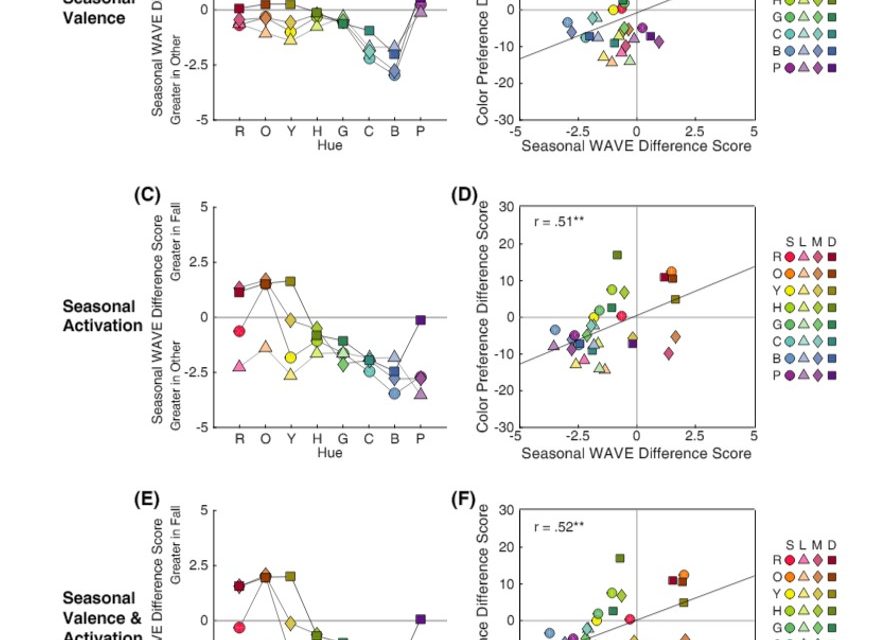
Seasonal differences were most pronounced between fall and the other three seasons. Participants liked fallassociated dark-warm colors—for example, dark-red, dark-orange (brown), dark-yellow (olive), and dark-chartreuse—more during fall than other seasons. The EVT could explain these changes with a modified version of Palmer and Schloss’ (2010) weighted affective valence estimate (WAVE) procedure that added an activation term to the WAVE equation. The results indicate that color preferences change according to season, as color-associated objects become more/less activated in the observer. These seasonal changes in color preferences could not be characterized by overall shifts in weights along cone-contrast axes.
이 연구는 색상 선호도가 계절에 따라 어떻게 달라지는지, 그리고 이러한 변화가 생태학적 유의성 이론(EVT)에 의해 설명되는지 조사했다. 그렇게 하기 위해, 환경 색에 큰 계절적 변화가 있는 미국 북동부 지역의 가을, 겨울, 봄, 여름에 동일한 색채에 대한 참가자들의 선호도를 평가했다. 계절적 차이는 가을과 다른 세 계절 사이에 가장 두드러지게 나타났다. 참가자들은 가을과 연관된 어둡고 따뜻한 색채(예: 어두운 빨강, 어두운 오렌지(브라운), 어두운 노란 색(올리브 색), 어두운 샤르뜨뤼즈색을 다른 계절에서 보다 가을동안에 더 좋아했다. PCBA는 파머와 슐로스(2010)의 수정 버전으로 이러한 변화를 설명할 수 있으며, 이는 WAVE방정식에 활성화 용어를 추가한 가중 정서적 발랑스(WAVE)절차이다. 이 결과는 관찰자에서 색상과 관련된 개체가 더 이상 활성화되지 않게 되면 계절에 따라 색상 기본 설정이 변경됨을 나타냅니다. 이러한 색상 선호도의 계절적 변화는 원뿔 대비 축에 따른 전체적인 체중 이동으로 특징 지어질 수 없었다.
원문보기 : Cognitive Science